002. AST Compiler Optimization & N-ary Flattening Strategy
Context
In ADR-001, we decided to transition from a Closure-based evaluation engine to an AST-based compilation approach.
While the initial AST implementation solved the "logic black box" issue and enabled advanced features like Trace/Skip, it hit two performance bottlenecks at large-scale rule composition (e.g., depths of 1000+).
It sounds rather perverse. In real-life scenarios, highly unlikely such a thing would exist:
- Runtime
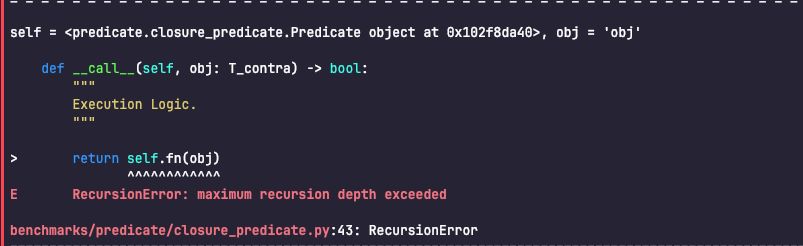
RecursionError: the generated AST was a deeply nested binary tree—Call(Call(...))—causing the interpreter to hit recursion limits during execution.
closure_recursion
- Build cost explosion: Python's
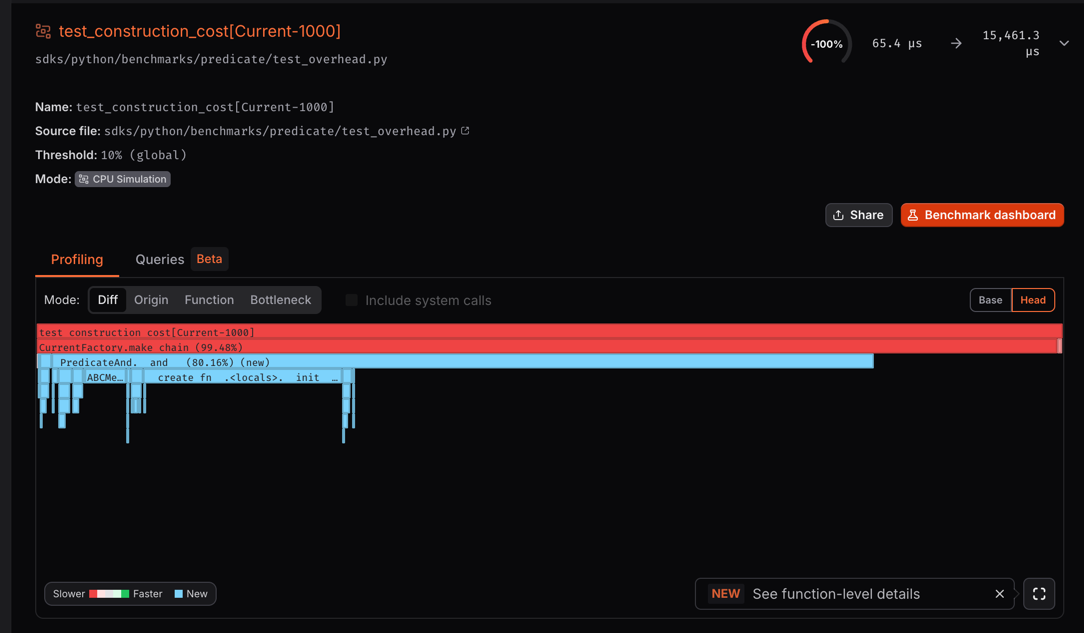
&is left-associative, causing tuple-copying overhead when buildingA & B & C .... A 2000-node rule took over 100ms to construct, significantly slower than native Python import overhead.
The first version of the AST incurred significantly higher construction costs compared to closures.
We need an architecture that delivers native Python execution speed, extremely low build cost, no recursion depth limit, and observable intermediate state.
Exploration
We tried several approaches:
-
Closure approach: chained
lambdafunctions. Execution speed was fine, but it hit Python's recursion limit at depths >1000 and couldn't support transparent Tracing or full Audit evaluation. -
Naive AST approach: maintaining a flat
childrenlist in__and__at build time. Generated flat runtime code, but the memory copying during construction was unacceptable. -
Lazy build + compile-time flattening: shift the flattening burden from build time to compile time. This is the current approach.
Decision
1. Lazy Binary Construction
To resolve the build performance issue, we degraded __and__ and __or__ to simple binary tree construction.
A & B no longer tries to merge lists; it creates a binary node (self, other) directly. Each & drops from O(N) (tuple copying) to O(1) (binary node allocation), so an N-rule chain builds in O(N) not O(N²). We also added Predicate.all([...]) and Predicate.any([...]) as static methods that use tuple(list) internally for true batch allocation.
2. Smart Compiler
Since the build phase now generates a "left-leaning binary tree," compiling it directly would produce inefficient, stack-overflow-prone code. We introduced an Iterative Chain Collector in the Compiler.
When the compiler encounters an AND/OR node, it greedily drills left (iterative drill-down), reconstructing the nested binary structure into a flat list [Leaf_1, Leaf_2, ..., Leaf_N]. The output is ast.BoolOp(values=[...]) (N-ary), which the interpreter executes linearly with zero stack frame overhead.
3. Tiered Execution Strategy
The default uses Predicate.all/any + Compiler. For the default scenario (short-circuit on, Trace off), compiled Runners are cached via __slots__, so subsequent calls have zero overhead.
Results & Benchmarks
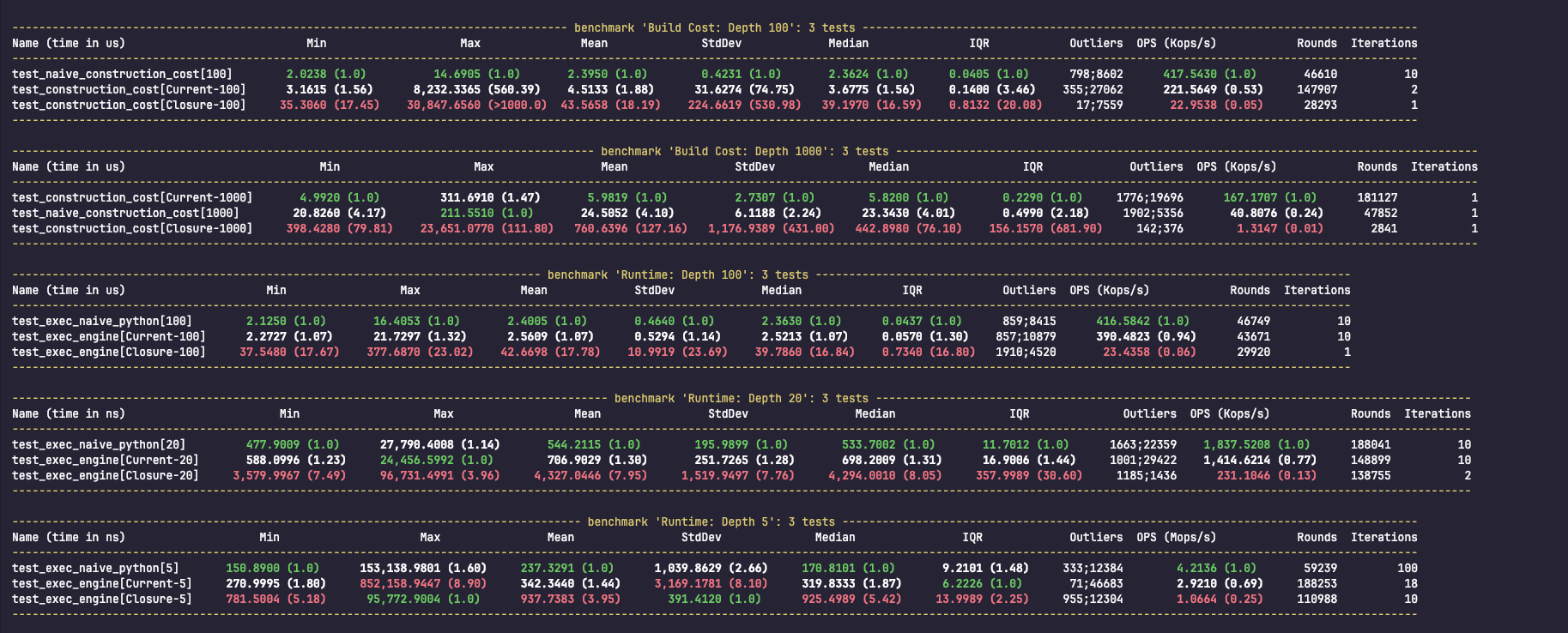
We benchmarked three implementations across varying depths. Local pytest-benchmark results show high variance due to GC interference; CodSpeed provides the authoritative measurements in a controlled environment.
| Metric | Naive Python (def) |
Closure (Legacy) | Current (AST) |
|---|---|---|---|
| Build (D=100) | ~2.4µs | ~40µs (17x slower) | ~3.7µs (1.5x) |
| Build (D=1000) | ~23µs | ~443µs (127x) | ~5.8µs (4x faster) |
| Runtime (D=100) | ~2.4µs | ~40µs (17x slower) | ~2.5µs (1.07x) |
| Runtime (D=20) | ~534ns | ~4.3µs (8x slower) | ~698ns (1.3x) |
| Max Depth | 1000 (RecursionError) | 1000 (Stack Overflow) | ∞ (Iterative) |
Key Achievements
At depth 1000, the current implementation builds 4x faster than handwritten Python and 127x faster than the closure approach (eliminating O(N²) tuple copying). Runtime lands within 7% of native Python (def) while maintaining full observability — the closure approach is 17x slower at the same depth. Iterative compilation removes Python's 1000-frame recursion limit entirely.
Trade-off: the current approach pays a small (~7%) runtime cost for Trace/Audit capabilities. For hot paths requiring minimal overhead, consider disabling tracing or using naive Python for shallow chains (D<50).
Limitations & Caveats
Despite the performance gains, there are trade-offs in the design and gaps in the current test coverage:
-
Heterogeneous tree overhead. Compiler optimizations work best on pure AND or pure OR chains (current benchmarks only cover this case — contributions welcome). Mixed trees like
(A & B) | (C & D) | ...degrade to ordinary recursive compilation; correctness is maintained but compile time increases slightly. -
Benchmark bias. Current benchmarks (
test_stability.py) target depth-2000 pure AND chains — the compiler's sweet spot. Wide, shallow, or complex nested trees won't see gains as dramatic, though they remain better than the closure approach. -
Unquantified overhead for advanced features. Enabling
trace=Trueorshort_circuit=Falseinjects additional helper functions. We haven't benchmarked Trace Mode rigorously, but expect it to run 2–5x slower than Default Mode due to object allocation and string formatting — the necessary cost of observability. -
Static type checking reliance. To maximize build performance,
Predicate.allremoves runtime type checking (isinstance). We rely entirely on static type checkers (mypy/pyright/ty) to catch argument errors. A non-Predicateobject forced into the list will surface at compile time or runtime, not at the call site.
Real-world Impact
In real business scenarios, rule execution is typically I/O-bound (fetching user profiles, querying databases). The engine's 15µs execution time is negligible against network latency. The benchmark depth of 2000 is a stress test; real business rules rarely exceed 10–20 levels, and infinite-depth support is a reliability guarantee, not a daily requirement.
The primary motivation for this work was observability and flexibility, not raw speed. We accept the small overhead of AST manipulation to unlock capabilities that hardcoded Python logic cannot provide: type-safe reusable rule blocks (is_adult, is_admin) that can be tested in isolation, transparent Tracing and Auditing middleware that tells you exactly which predicate failed, and rules that can be serialized and updated without redeploying (planned for a future release).